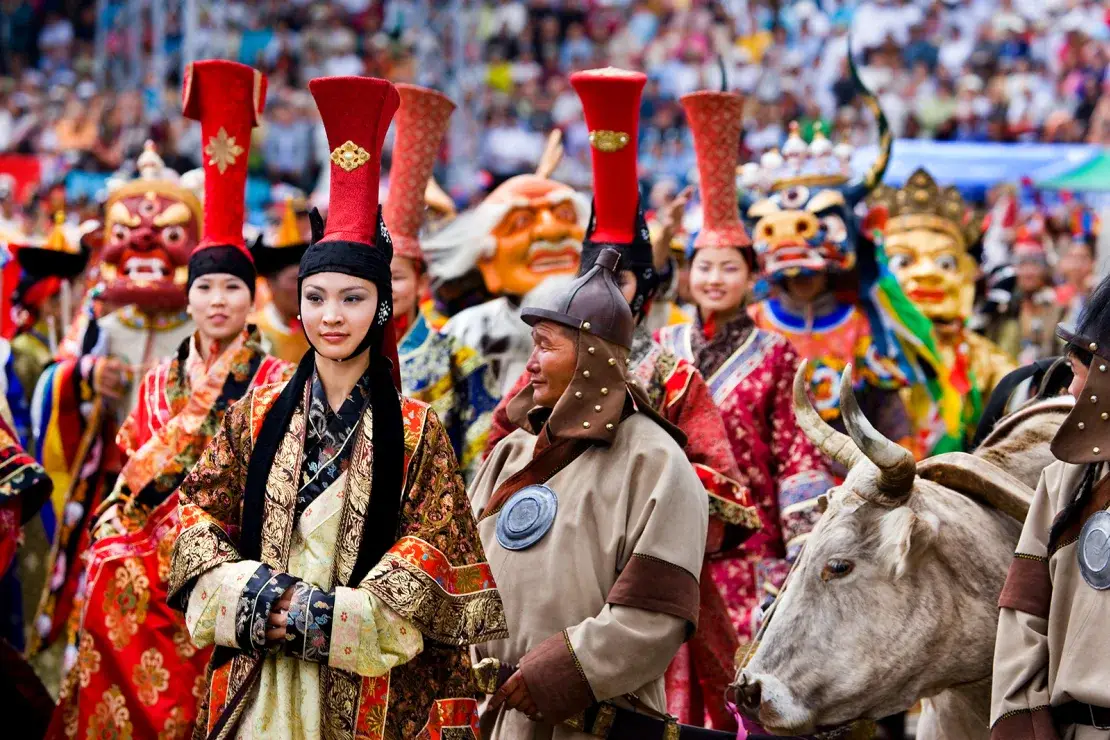
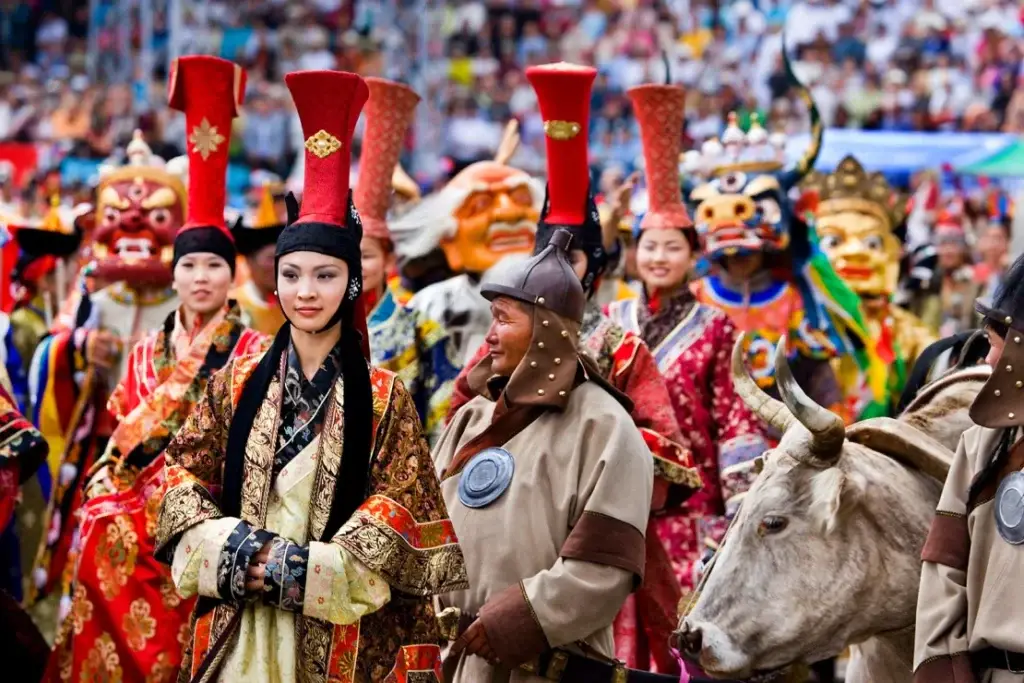
Naadam festival mongolia is a national festival celebrated every year from 11 to 13 July across Mongolia that focuses on three traditional games: horseracing, wrestling and archery. Mongolian Naadam is inseparably connected to the nomadic civilization of the Mongols, who have long practiced pastoralism on Central Asia’s vast steppe. Oral traditions, performing arts, national cuisine, craftsmanship, and cultural forms such as long song, Khöömei overtone singing, Bie biyelgee dance and Morin khuur fiddle also feature prominently during Naadam. Mongolians follow special rituals and practices during the festival, such as wearing unique costumes and using distinctive tools and sporting items. Festival participants revere the sportsmen, sportswomen, and children who compete, and winners are rewarded titles for their achievements. Ritual praise songs and poems are dedicated to the contestants in the events. Everyone is allowed and encouraged to participate in Naadam, thus nurturing community involvement and togetherness. The three types of sports are directly linked with the lifestyles and living conditions of the Mongols and their transmission is traditionally undertaken through home-schooling by family members, although formalized training regimens have recently developed for wrestling and archery. The rituals and customs of Naadam also accentuate respect for nature and the environment.
The Three Games of Mongolia
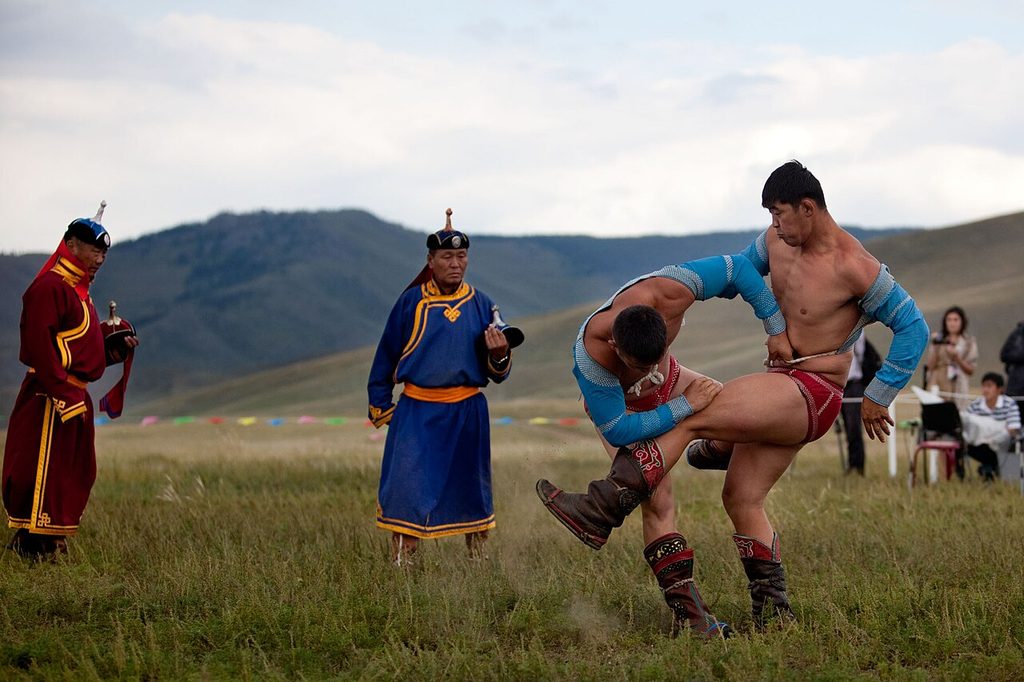
Bökh is the soul of Naadam. At the national festival 512 wrestlers (1,024 in anniversary years) meet in nine knockout rounds across two days. There are no weight classes and no ring boundaries: touch the ground with anything above your knee — a knee, an elbow, your head — and you are out.
The costume carries its own legends. The open-chested vest (zodog) and briefs (shuudag) are red for the eternal flame or blue for the eternal sky. The chest is open, so the story goes, because a woman once entered in disguise and defeated every man — since then the vest proves each competitor is male. The four-sided hat recalls the four ancient provinces of Mongolia, and every winner performs the devekh, the eagle dance, around the state banner.
Titles are earned by rounds won at the national Naadam and kept for life: Nachin (falcon) for five rounds, Khartsaga (hawk), Zaan (elephant), Garuda, Arslan (lion) for winning the tournament, and Avarga (titan) for repeat champions. Each wrestler is accompanied by a zasuul — a herald who sings his titles and holds his hat.
In 2011 Mongolia set a Guinness World Record with 6,002 wrestlers competing at once. To see the sport at its most intimate, watch the early rounds on the morning of 11 July, or any countryside naadam where the circle of spectators is the arena.
Horse racing at Khui Doloon Khudag
Not a racetrack — the open steppe. Races of 12 to 26 km, thousands of horses, and the giingoo song of young riders at dawn.
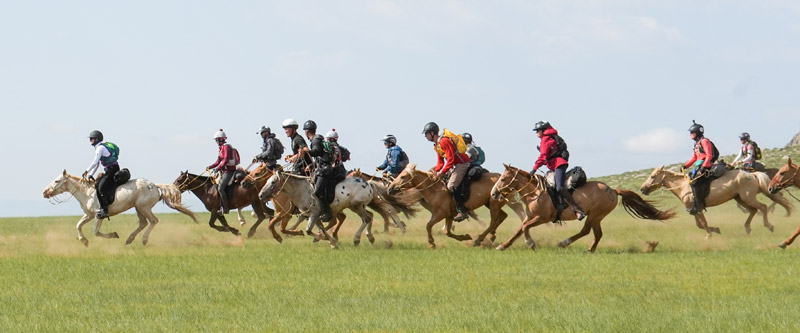
Mongolian racing is endurance racing across open country. Horses compete by age class, six in all, over distances that grow with age: two-year-olds (daaga) run 10–12 km, while seven-year-olds and stallions cover up to 23–26 km. Hundreds of horses start together in each race; across the festival thousands race in total.
The races start and finish at Khui Doloon Khudag, roughly 35 km west of Ulaanbaatar, where a temporary city of gers rises for the festival — airag bowls, khuushuur pans and horse trainers from every aimag. Everything here is free: no tickets, no stands, just the steppe and the finish line.
Riders are young — the sport belongs to children of herding families who grow up on horseback. Before the start they circle singing the giingoo, a high, ancient melody that calms the horses. The five leading horses of each race earn the title airagiin tav and are praised in verse; the winning trainer earns honours as carefully ranked as the wrestlers’. In the daaga race even the last horse is honoured with a song wishing it the ‘luck of ten thousand horses’ — bayan khodood.
Practical notes: the main races run on the mornings of 11–13 July, with key finishes around 12 July. Leave the city by 6 am, bring sun protection and water, and treat riders and horses with the distance you would give any athlete at work — drones are restricted near the courses.
Mongolian archery
Three traditions — Khalkh, Buriad, Uriankhai — one composite bow, and judges who sing the score.
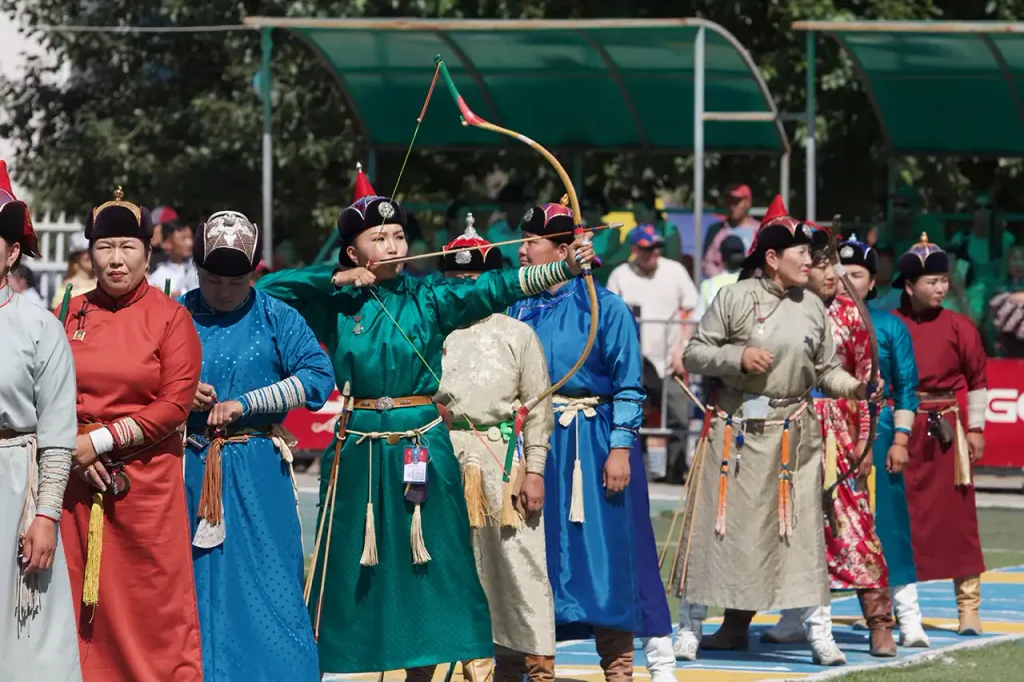
Mongolian archers shoot at sur — small woven leather cylinders stacked on the ground — from 75 metres for men and 65 for women in the Khalkh style. The bow is the ancient composite recurve of horn, birch and sinew that once ruled the steppe battlefield; arrows are birch with vulture-feather fletching.
Three regional traditions compete at Naadam. Khalkh archery is the most widespread and open to men and women; Buriad archery has its own targets and rhythm; Uriankhai archery, from Mongolia’s far west, remains men-only by custom. Teams alternate shots in a long, meditative rhythm punctuated by the uukhai — the rising praise chant the judges sing while raising both arms when an arrow strikes home.
Archery is held on the National Archery Field beside the main stadium across all three festival days, and it is completely free to watch. Stand close, listen for the uukhai, and you are experiencing a scoring system older than any scoreboard.
History of Naadam
From military training of the khans’ warriors to a UNESCO-inscribed national festival — eight centuries of the three games.
Naadam grew out of the military traditions of the Mongol Empire. Commanders selected warriors by testing the three skills every soldier needed on the steppe: strength and balance in wrestling, horsemanship over long distances, and precision with the bow. Organized contests of these ‘three games of men’ — Eriin Gurvan Naadam — accompanied state assemblies, weddings and religious gatherings for centuries.
Under Qing rule from the 17th to the early 20th century the great assemblies were restricted, but Mongolians kept the games alive in smaller local festivals tied to the worship of sacred mountains and ovoo cairns. When the People’s Revolution of 1921 restored Mongolian statehood, the games were fixed on its anniversary — 11 July — and Naadam became the national holiday it is today.
The modern national Naadam is held every 11–13 July in Ulaanbaatar, opening with a ceremony of the Nine White Banners at the National Sports Stadium. In 2010 UNESCO inscribed Naadam on the Representative List of the Intangible Cultural Heritage of Humanity, recognizing not only the three games but the long song, khöömii overtone singing, bie biyelgee dance and morin khuur fiddle woven through the festival.
Naadam is not a show staged for visitors — it is Mongolia’s own celebration of statehood and nomadic identity, celebrated in every aimag and soum across the country. That is exactly what makes it worth travelling for.