
A felt-covered, circular tent that can be taken down in an hour or two, the ger has housed Mongolians for centuries. Here is how it is built, how the space inside is organised and why it still matters.
Drive out of Ulaanbaatar in almost any direction and, sooner or later, a small white circle appears on the steppe. It is a ger (гэр), the round, felt-covered dwelling in which a large part of Mongolia’s population has lived for centuries. Outsiders often call it a yurt, a word of Turkic origin, but in Mongolian the word simply means “home”. The ger is more than a tent: it is a carefully engineered building, a map of the family’s social order and a symbol of the nomadic way of life.
A building that folds into a truck
A ger is made of a handful of standard parts, which is why a family can pack it up, move it and put it together again in a different valley. The skeleton consists of:
- Khana – collapsible lattice wall sections made of thin wooden slats joined with leather or rope. Stretched out in a circle, they form the walls; a typical family ger uses four or five of them.
- Uni – long, slender roof poles that run from the top of the wall to the crown, like the spokes of an umbrella.
- Toono – the round crown wheel at the top of the roof. It lets smoke out and light in, and in many families it is handed down from one generation to the next.
- Bagana – one or two central pillars that support the toono in larger gers.
- Door – a small, brightly painted wooden door, traditionally facing south, which shelters the interior from the prevailing north winds.
Over the frame go layers of sheep’s-wool felt, pressed and rolled by hand, and an outer cover of white canvas. In winter extra felt is added; in summer the lower edge can be rolled up to let the air through. Belts of horsehair rope are tied around the outside to keep the whole structure tight against the wind. An experienced family can put up a ger in an hour or two and take it down even faster.
How the space inside is organised
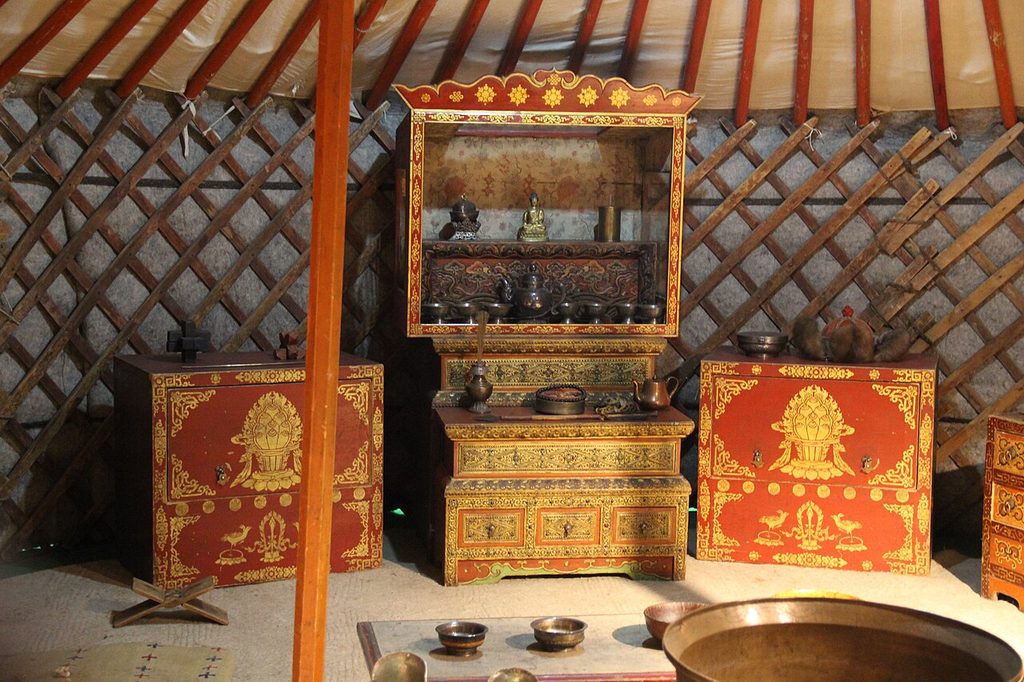
The inside of a ger follows an old, widely understood plan. The hearth sits in the middle, directly beneath the toono, and the stove is still the centre of family life: tea is boiled on it, food is cooked on it and the family gathers around it in the evening. The door is on the south side; opposite it, at the northern end, is the most honoured place, the khoimor. This is where the family altar, photographs, religious objects and the best furniture are kept, and where an honoured guest is invited to sit.
Traditionally the west side, on the left as you enter, is the men’s side, where saddles, harnesses and hunting equipment are stored. The east side, on the right, belongs to the women and holds kitchen equipment, milk containers and food. Beds are placed along the walls, and a small low table is set near the stove. Even today, many families still arrange their ger this way, although the strictness of the rules varies from household to household.
Why the ger works so well
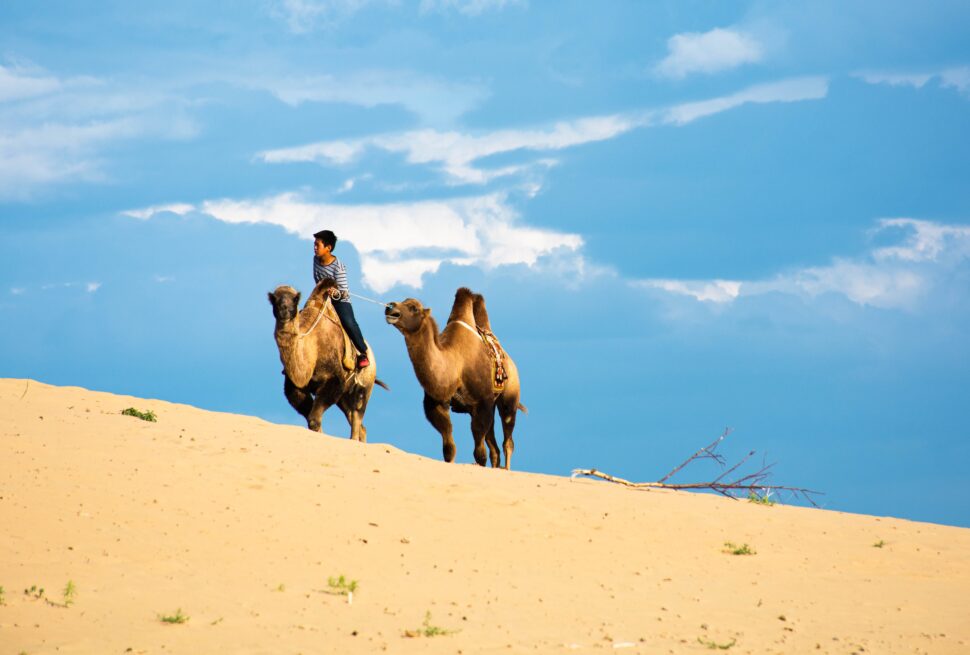
The design is perfectly adapted to the Mongolian climate. The circular shape sheds wind from every direction, while thick felt insulates against temperatures that fall far below –30°C in winter. A small stove heats the interior quickly, and the toono provides ventilation. In summer, when daytime temperatures can be high, the walls can be opened for a breeze. Because the whole structure is light, it can be transported on a pair of camels, an ox cart or, today, the back of a small truck.
The ger today
Modern gers look a little different from those of a hundred years ago. Many now have a solar panel for lighting and charging phones, a satellite dish for television, and a small chimney-stove. Some families use a motorbike or a pickup truck instead of camels to move camp. In tourist areas, ger camps offer visitors beds, heating and sometimes private bathrooms, in a structure that still follows the traditional pattern.
The ger also has a very different life in the capital. Large areas on the edge of Ulaanbaatar, known as ger districts, are made up of gers and small houses on fenced plots. There the ger is not part of a seasonal migration but a permanent home, often without running water or a connection to the central heating network. The comfort, warmth and cost of living in these districts are among the most debated social questions in the country, and many families see apartment housing as the ultimate goal.
Even so, the ger remains an important part of Mongolian identity. Its toono appears in art and on buildings, and families who have lived in apartments for years often keep a ger at the family’s summer pasture or on a plot outside the city. When a Mongolian family says that it is “going home” for the holidays, it is quite often a ger on the steppe that is meant.