No weight classes, no time limit and a ceremonial eagle dance after every win. A guide to the oldest of Mongolia’s “three manly games” and the champions it has produced, from Naadam to the sumo ring.
The rules in brief
Bökh looks simple, but it has its own distinct rules and customs, which are different from those of Olympic wrestling or judo:
- There are no weight classes. A heavyweight can be matched against a much lighter opponent, and a wrestler’s skill and balance count for as much as his size.
- There is no time limit. A bout ends when one wrestler loses.
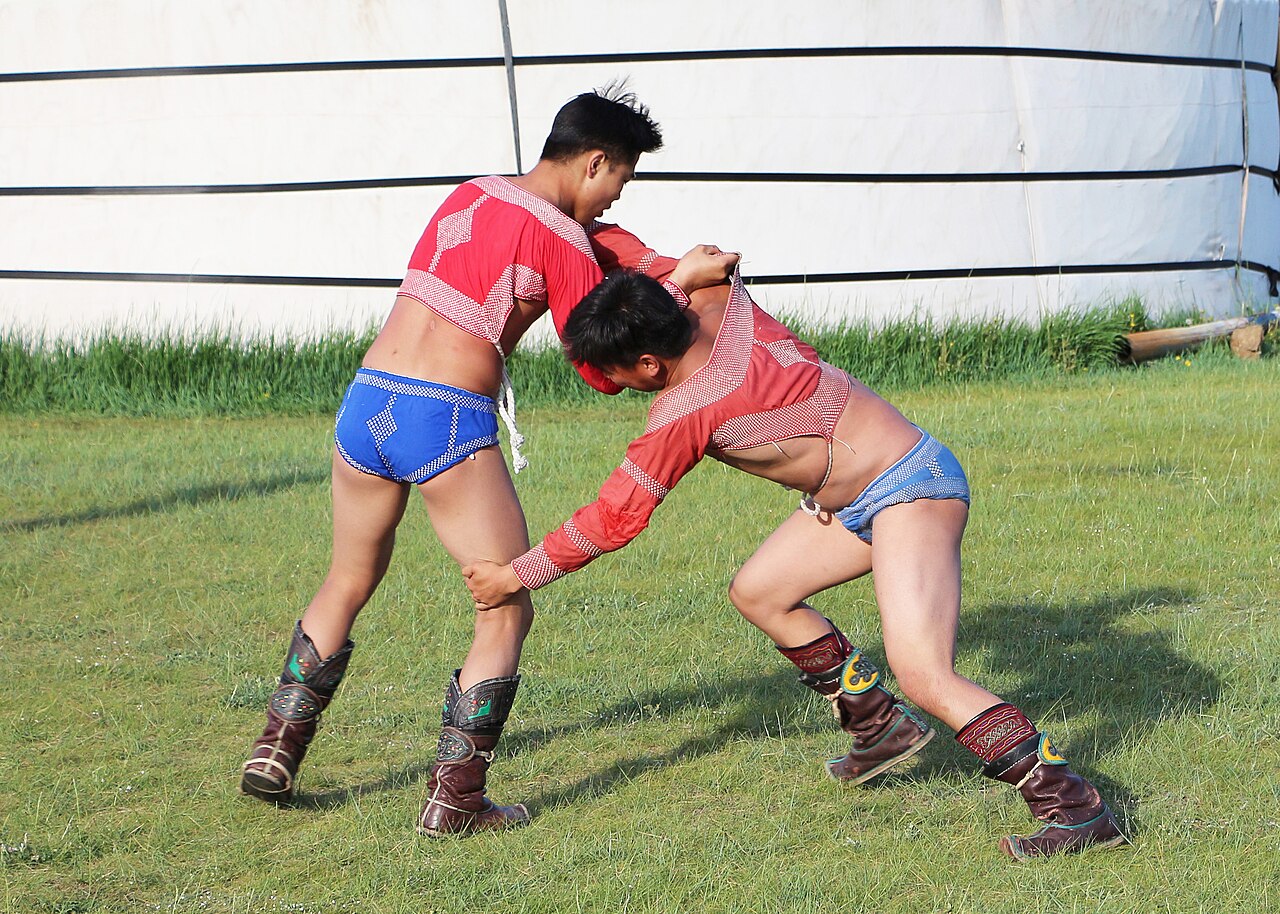
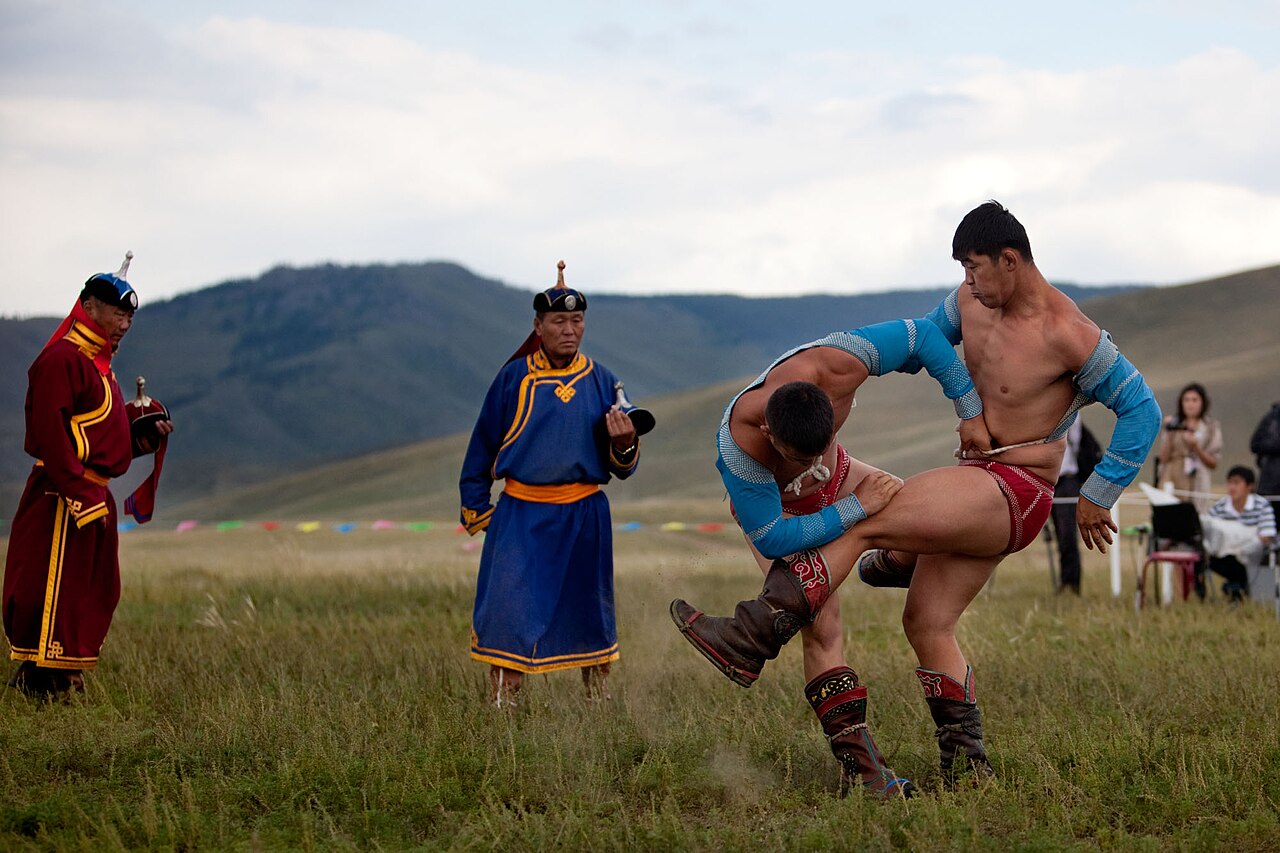
- A wrestler loses if his knee, elbow or any other part of his body, apart from the soles of his feet and his hands, touches the ground. Points are not scored.
- Grabs and trips are allowed, but attacks below the belt with the hands, pulling hair and striking are not.
- Wrestlers are paired by a draw in the first round. After that, the winners are matched in successive rounds, and a tournament of 512 wrestlers needs nine rounds to decide a champion.
The costume
The wrestler’s outfit is a part of the tradition. It consists of a tight, short-sleeved jacket called a zodog that covers the shoulders and the back but is open at the chest, tight shorts called shuudag, a pointed cap and heavy leather Mongolian boots (gutal) with upturned toes. Tradition says that the open chest of the jacket was introduced after a woman who had disguised herself as a man won a tournament in the past, and the open front is meant to ensure that every competitor is male. Whether or not this story is true, it is widely repeated.
Every wrestler is accompanied by a second, the zasuul, who stands behind him and takes his cap and jacket, and encourages him during the match. The second is often a former wrestler himself, who also helps with the rituals.
Eagle dance and titles
Before the first round, wrestlers perform a ritual dance called devekh, in which they open their arms and move like an eagle in flight, slap their thighs and circle the flag of the tournament. Winners repeat the dance after a victory, and the defeated wrestler traditionally ducks under the winner’s arm as a sign of respect. The whole performance, which is accompanied by a song of praise from a herald, is as important to the audience as the matches themselves.
Titles are given to the winners in national tournaments, and they follow a fixed hierarchy that is based on how many rounds a wrestler wins at the State Naadam:
- Nachin (Falcon) – for a wrestler who wins the fifth round.
- Zaan (Elephant) – for a wrestler who wins the seventh round.
- Arslan (Lion) – for the champion who wins the final round.
- Avarga (Titan or Giant) – the highest title, awarded to a wrestler who wins at the State Naadam twice or more.
These titles are used before a wrestler’s name for the rest of his life, and they bring respect in society, public appearances and, often, financial rewards.
Wrestlers beyond Naadam
Mongolian wrestlers have also found success outside the country. In international sports such as freestyle wrestling, judo and sambo, Mongolia has won Olympic and world medals. The most visible example is sumo in Japan, where Mongolian wrestlers have dominated the top rank for the past two decades. Several Mongolian-born athletes have become yokozuna, the sport’s highest rank, and the most successful of them, Hakuho, won a record 45 tournament titles before retiring in 2021. His father had won an Olympic silver medal in wrestling for Mongolia in 1968, a reminder of how closely bökh is linked to sporting family traditions.
Women and change
For a long time, bökh was exclusively a sport for men, and at the State Naadam it still is. However, women’s wrestling has become increasingly visible in recent years at local competitions and in international sport, and girls take part in training. The debate about whether women should participate in the traditional competitions and how the costume might be adapted continues, as people seek to balance respect for tradition with changing attitudes.
There are also concerns about injuries and the safety of the sport, the high weight of some competitors and the role of money. But for the great majority of Mongolians, the attraction of bökh is unchanged: the sight of two strong and skilled athletes, wearing the same costume as their predecessors, testing their strength and balance in the open air, while the crowd watches in silence and cheers at the key moment.