In the Mongolian countryside a stranger who knocks on the door is never turned away. Here are the customs of welcome, tea and food that guide visits to a ger, and the reasons behind them.
On the open steppe, where the nearest neighbour may be several kilometres away and winter temperatures are dangerous, a household that turns a traveller away is failing a basic duty. Hospitality in rural Mongolia is not simply good manners; it grew out of the practical reality that anyone might need shelter, food and water one day. That is why a visit to a ger comes with a set of customs that most Mongolians learn as children and that visitors are happy to pick up.
Arriving
Traditionally a visitor who approaches a ger calls out to the dogs, and the family’s own dogs are not meant to be approached before the owner has called them off. It is polite to wait outside until someone invites you in. In many areas people still say “Nokhoi khorio” – “hold the dog” – as a greeting before stepping up to the door.
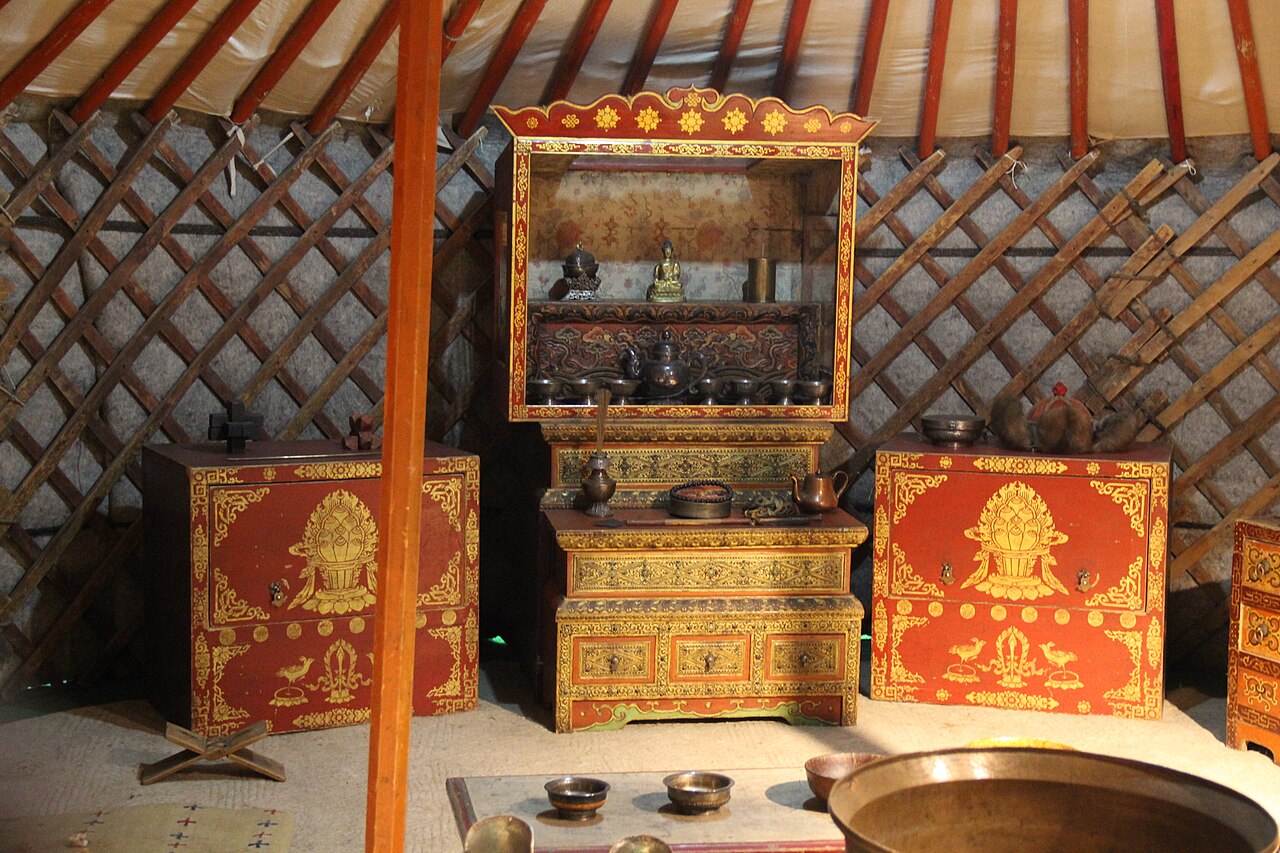
Once inside, a guest customarily turns to the left, towards the west side of the ger, and moves clockwise around the stove. A few rules apply to the entrance itself:
Do not step on the threshold. It is regarded as the boundary of the home, and stepping on it is thought to bring bad luck.
Take off a hat only if you are asked to; in the countryside hats are often kept on, and a hat is treated with respect.
Do not lean against the central pillars or put your feet towards the hearth or the family altar.
Avoid throwing rubbish or anything unclean into the stove, which is treated as the centre of the family’s fortune.
Tea, milk and the first cup
Almost as soon as the guest sits down, the hostess will offer a bowl of suutei tsai, the salty milk tea that is the everyday drink of the countryside. Depending on the season, there may also be bowls of dried curds (aaruul), butter, cream, biscuits and other dairy products. It is customary to accept the bowl with the right hand, or with both hands, with the left hand supporting the right elbow as a sign of respect. Even if you do not drink the tea, you should take the bowl and touch it to your lips before passing it back. Refusing outright can be taken as discourtesy.
In summer, guests are often offered airag, the lightly fermented mare’s milk that is drunk throughout the Naadam season. A first-time visitor may find its sour, slightly fizzy taste unusual, but a few sips are enough to satisfy politeness.
Greetings, snuff bottles and the blue scarf
An old form of greeting between adults is the exchange of snuff bottles. The two people take each other’s bottle with the right hand, sniff the lid or lift it to the nose, and give it back without opening it too far. The custom is less common among younger people today, but it can still be seen at festivals and family gatherings, especially among older men.
For formal occasions – a wedding, a new baby, the New Year – the family may give or receive a khadag, a long strip of blue silk. It is held in both hands, the open fold facing the receiver, and signifies respect, sincerity and good wishes. Blue is the colour of the sky, which in Mongolian culture is a symbol of eternity.
Food and farewells
A guest who arrives at a ger will rarely leave without having eaten. Depending on the season and the occasion, the meal may be dumplings, noodles with mutton, or a whole boiled sheep prepared for a special visit. The host may pass a piece of meat to the guest as a sign of respect; it is polite to take at least a little and to praise the food. When the meal is done, it is courteous not to rush away.
When a visitor leaves, the family usually walks them to the door, and sometimes further. In Mongolian tradition a guest should not be allowed to leave hungry or without good wishes for the journey. In some regions, the host will offer a small gift – a package of aaruul or a piece of bread – for the road.
Why the customs matter
These rules are not archaic formalities. In a country with about 3.4 million people and one of the lowest population densities in the world, such courtesies help strangers trust one another quickly and establish a common ground. They also reflect a deeper worldview in which the home, the hearth and the guest are treated with reverence.
Visitors from outside need not memorise every rule. Hosts are usually patient and amused by foreigners’ mistakes, and a smile, a respectful attitude and a willingness to try what is offered tend to count for more than perfect etiquette. Still, knowing the customs shows the family that you value their home – and in a Mongolian ger, that is the best way to be welcomed.