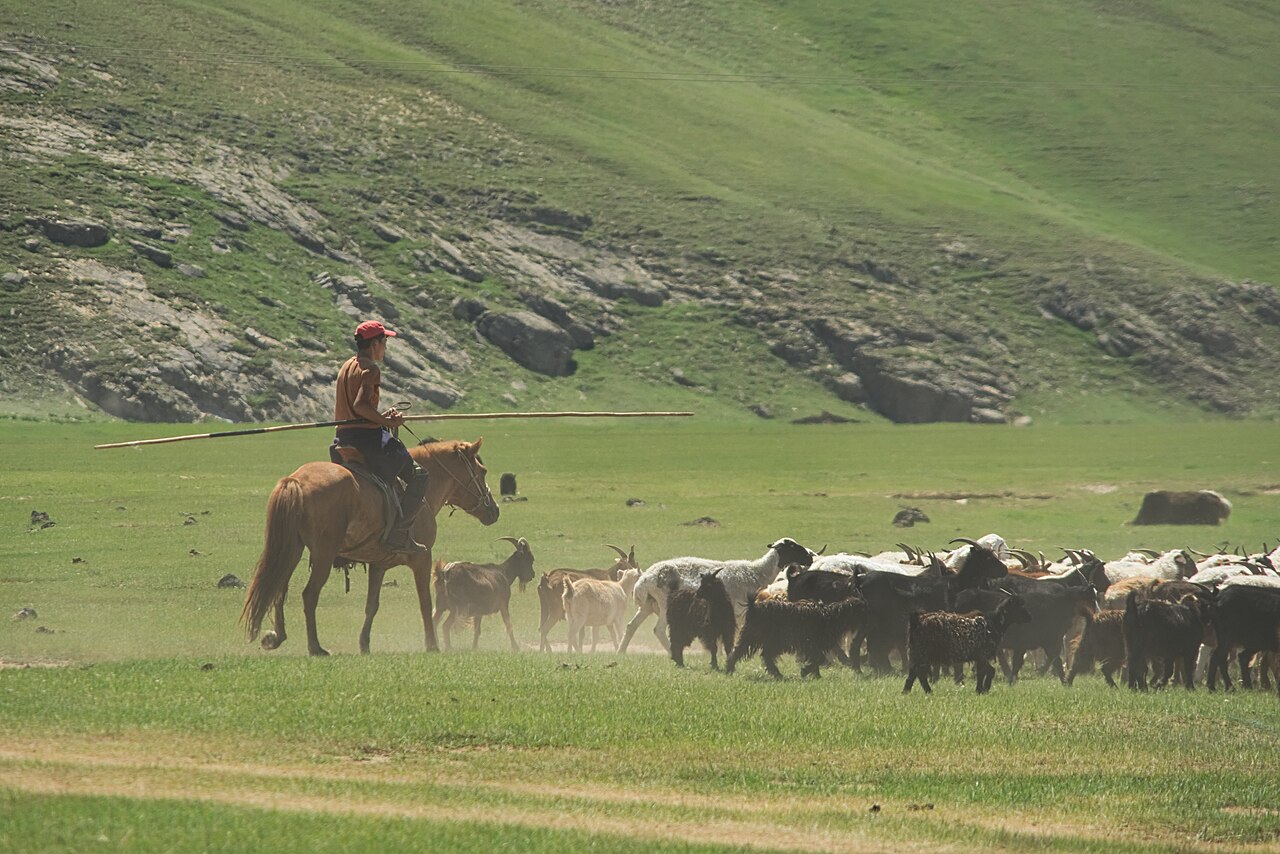
Nomadic herding today take care more than 60 million animals graze Mongolia’s grasslands, and herding still supports a large share of the country’s households. How seasonal movement, private herds and risk shape life on the steppe.
Mining dominates Mongolia’s exports, but ask a Mongolian what the country’s economy is built on and many will point to livestock. Official statistics count more than 60 million sheep, goats, cattle, horses and camels – about 18 animals for every person – and herding remains the main livelihood for a large share of rural households. Roughly a quarter of the country’s workforce is employed in agriculture, mostly in animal husbandry, even though the sector accounts for a much smaller share of national output than mining.
Five animals, many products
Mongolian herders traditionally keep “five snouts”: horses, camels, cattle (including yaks in the mountains), sheep and goats. Each plays a different role in the household economy.
- Sheep provide meat, wool and fat. Mutton is the staple of the winter diet.
- Goats are the source of cashmere, a cash crop that has made them the most numerous animal in many regions.
- Cattle and yaks give milk, meat and hides, as well as draught power.
- Horses are used for herding and transport, and their milk is made into airag.
- Camels are used in the Gobi for transport, wool and milk.
Families sell cashmere, wool, hides and live animals to traders or at local markets, and meat is increasingly sold to processing plants and exported. Cashmere is one of the best-known products, and Mongolia is one of the largest suppliers of raw cashmere in the world.
The rhythm of the seasons
Pastoralism in Mongolia is based on mobility. Most herder families have four seasonal camps: a winter camp in a sheltered valley, a spring camp where animals give birth, a summer camp near water and a lush pasture, and an autumn camp where the animals fatten before winter. Moving between them, usually over distances of a few dozen kilometres, allows the grass to recover and reduces the risk of overgrazing.
In emergencies – drought, heavy snow or the threat of a dzud – families may make a long-distance move called otor, sometimes hundreds of kilometres, to find better pasture. Because it follows the grass, a herding family’s year is a constant calculation of weather, distance, labour and the condition of the animals.
From collectives to private herds
During the socialist period, from the 1920s to 1990, most herders worked in state-run collectives called negdel. The animals belonged to the collective, and herders received a salary, services and a share of the products. After the democratic changes of 1990, the herds were privatised, and families suddenly became responsible for their own animals, pasture and marketing.
The consequences were large. The number of livestock rose sharply, from about 25 million in 1990 to more than 70 million in the early 2020s, and the share of goats increased, driven by high cashmere prices. At the same time, the collapse of the old system left gaps in veterinary services, transport and market access. In the 1990s, many people who had lost their jobs in cities returned to herding, and herder households grew as a share of the population.
The risks of a living on the land
Herding is among the riskiest ways to earn a living. The main threats are:
- Dzud: severe winters that kill millions of animals. The dzud of 1999–2002 and 2009–2010 each wiped out a significant share of the national herd and pushed many families into poverty.
- Drought and the effect of rising temperatures on pasture growth.
- Overgrazing, particularly around towns, wells and roads, where large concentrations of animals damage the soil.
- Price swings for cashmere, wool and meat, which are set largely on international markets.
- Distance from services, since herder families may be hours from the nearest soum centre and children often live in school dormitories during the term.
New approaches
The government and development partners have tried to reduce these risks through a range of measures. They include index-based livestock insurance, which pays out when winter mortality in a district exceeds a set level, herder cooperatives that help families sell products at better prices, and community pasture management groups that agree on rules for grazing. Some projects promote better breeding, the production of sustainably certified cashmere and the use of solar power and mobile phones in the countryside.
Many herder families have also taken advantage of modern technology. Motorbikes have become a common way of herding and travelling, solar panels power televisions and phone chargers, and mobile networks allow families to check prices and weather forecasts.
An unfinished debate
The future of herding is a subject of continuous discussion. Supporters of more land reform argue that clearer rights to pasture would encourage herders to look after it, while others fear that privatisation would exclude poorer families. Some economists believe that processing meat, dairy and wool in Mongolia, instead of exporting raw materials, could create jobs and add value. Whatever the path chosen, the mobile herding system that has sustained Mongolians for centuries is likely to remain at the heart of the country’s economy and identity.