In the Orkhon Valley stands Mongolia’s oldest surviving Buddhist monastery, built beside the site of the 13th-century capital of the Mongol Empire. A guide to what remains, what has been lost and why the valley matters.
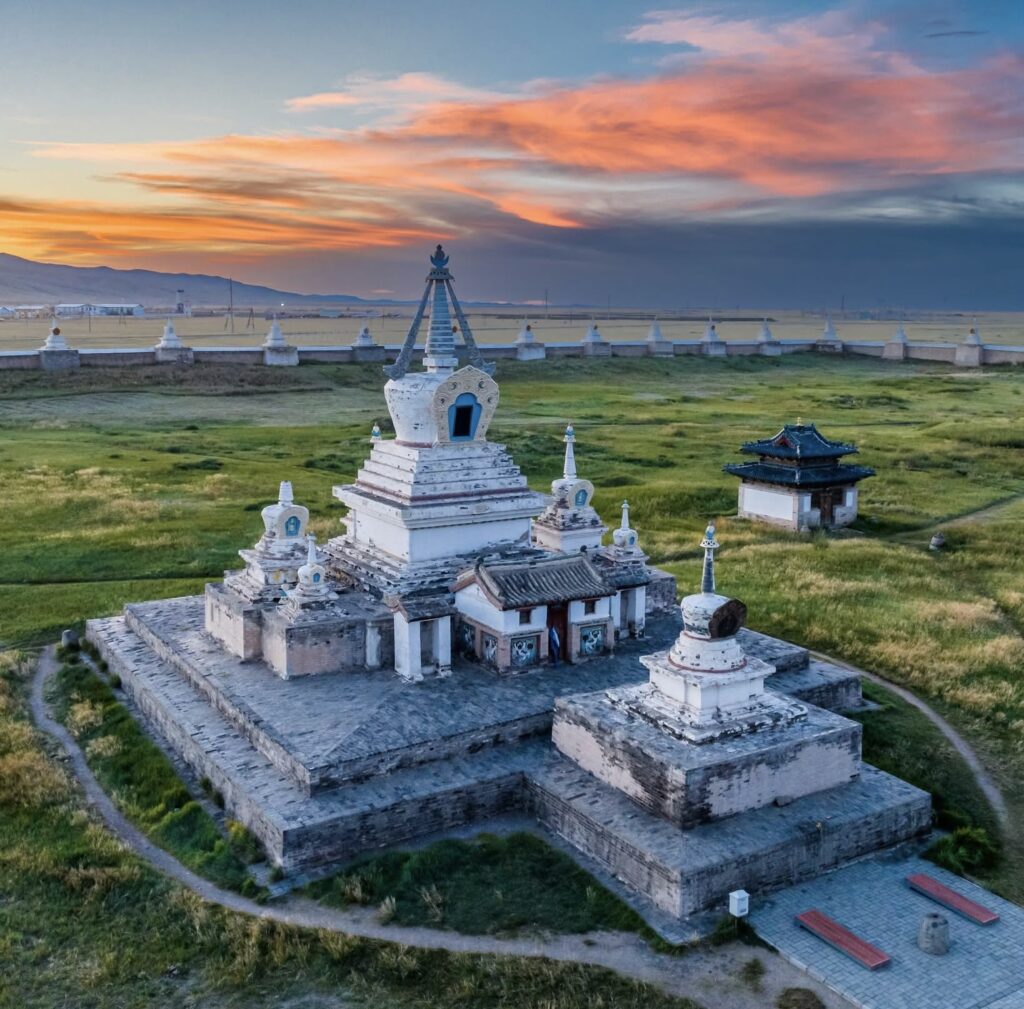
About 370 kilometres west of Ulaanbaatar, where the Orkhon River winds through a broad grassy valley, a white wall studded with 108 stupas encloses a handful of temples. This is Erdene Zuu, the oldest surviving Buddhist monastery in Mongolia. Just next to it, under the grass, lay the capital of one of the largest empires in history. Together, the monastery and the ruins of Karakorum make the Orkhon Valley one of the most meaningful places in the country.
The capital of the Mongol Empire
Karakorum (Kharkhorum in Mongolian) was chosen as a base by Chinggis Khaan and built up by his son and successor Ögedei in the 1230s. The location had been important long before: earlier steppe empires, including the Uyghur Khaganate and the Göktürks, had established centres in the same valley, and the area lay on trade routes between China, Central Asia and the west.
The city was not a typical city in the way a European or Chinese city was. It had a walled core with a palace, workshops, temples, a mosque and Christian churches, and surrounding it lay a vast encampment of tents. Visitors reported on its remarkable diversity. The Franciscan friar William of Rubruck, who visited in the early 1250s, described a place where craftsmen from across Eurasia worked side by side, where different religions were practised and where a famous silver tree with a mechanical fountain stood in front of the khan’s palace.
The city’s importance did not last long. When Kublai Khan moved the centre of the empire to what became Beijing in the 1260s, Karakorum declined. It was damaged in the wars that followed the fall of the Yuan dynasty, and by the 14th century, little was left of its former importance.

A monastery built from a lost city
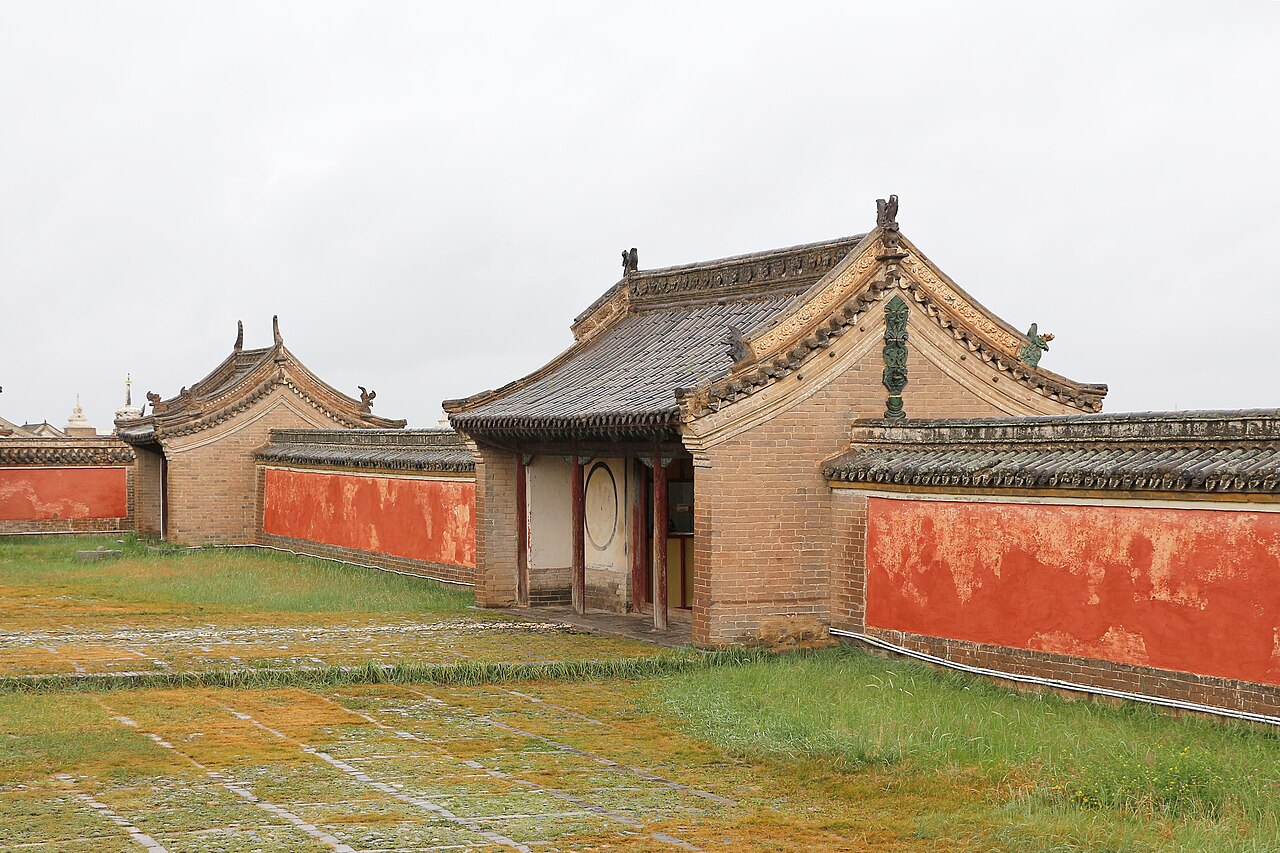
Erdene Zuu was founded in 1586 by Abtai Sain Khan, a ruler of the Khalkha Mongols, soon after Tibetan Buddhism had been adopted as a state religion by the Mongol nobility. According to tradition, the builders used stones and bricks from the ruins of Karakorum. The complex was designed on a grand scale, with temples built in a mix of Mongolian, Tibetan and Chinese styles and a perimeter wall of about 400 metres on each side. The 108 stupas along the wall are a reference to the 108 beads of a Buddhist rosary.
At its height, the monastery housed up to a thousand monks. It suffered damage in the late 17th century in conflicts with the Dzungars and was partly restored, but its greatest destruction came in 1937, when the socialist government’s anti-religious campaign led to the closure of most of Mongolia’s monasteries. The monks were arrested or killed, and many of the buildings were destroyed. Only three temples and the outer wall survived, largely because the authorities decided to keep the site as a museum.
World Heritage and a living place
In 2004, UNESCO added the Orkhon Valley Cultural Landscape to the World Heritage List. The inscription covers a wide area that includes Karakorum, Erdene Zuu and other sites from the Turkic and Mongol periods, because the valley shows how nomadic pastoralism, trade and political power were connected over many centuries. Archaeologists have also identified the remains of the palace complex of Karakorum and parts of the city’s crafts quarter.
After 1990, Erdene Zuu was handed back to the Buddhist community. A few monks now live and pray there again, and ceremonies are held in the temples. Visitors walking inside the wall can see the Golden Stupa, a small temple with a collection of Buddhist art and the main temples that have been restored.
Why it still matters
For many Mongolians, Karakorum is a symbol of the period when their ancestors ruled over a large part of Eurasia. Plans to rebuild or reconstruct parts of the old capital have been discussed several times, and the question of how to present the site responsibly is a continuing debate. At the same time, the pressure of growing tourism, the dry climate and the preservation of unexcavated remains pose challenges to the authorities who manage the valley.
For a visitor, Erdene Zuu offers a quiet and affecting experience. A morning walk among the stupas, with the monks’ prayers drifting across the grass and horses grazing in the distance, gives a sense of continuity – a place where, even after centuries of war, change and suppression, people have continued to gather to pray.